Roman Oseghale's blog

________Leadership and advancement


Leave a comment

Is Critical Thinking Dead?………..

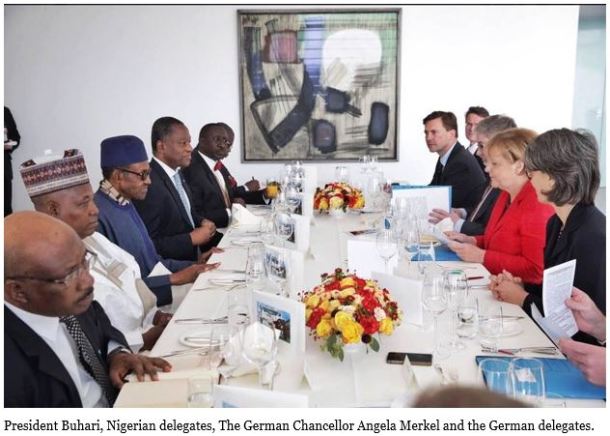
president-buhari-and-nigerias-delegation-to-germany

“A great deal of intelligence can be invested in ignorance when the need for illusion is deep”……Saul Bellow

Is Nigeria breeding high level educated illiterates or an intellectually lazy generation?……Why you should never jump to conclusions based on headlines or photos..

What is Critical Thinking?

“The Objective analysis and evaluation of an issue in order to form a judgement”

Why are people jumping to conclusions reading headlines and posting photos without critically analysing the situations?…..People have been circulating this photo on social media claiming President Buhari and his team went to Germany for Negotiations unprepared, what are the processes of negotiations?….and let us analyse the possible case scenarios…..

 Why did President Buhari Travel to Germany to see the German Chancellor?

  1. Cooperation between the two Nations, which includes: Shared interests, further cooperation on security, humanitarian for IDPs, rehabilitation of North-East, including Trade and Economic Relations.
  2. Foreign Investments.
  • Government negotiations don’t just happen and are not concluded overnight, it is a long process that must have been set in motion for weeks, months, or even years before sitting around a table with the negotiation team having the due advantage setting most of the conditions…..these are due to negotiation processes and bureaucracy.
  • The negotiations can follow both formal and informal procedures done behind closed doors with technical experts at the negotiation stage, either in total secrecy before the final decisions are announced to the public or every milestone and progress is announced.

Possible Scenarios.

First Case Scenario……Pre-Negotiation stage!

Looking at the above reasons why Buhari Traveled, if the negotiations are just starting, Nigeria is the country seeking cooperation and direct investment, hence Nigeria will be the one to put together a proposal to the German government. The possible case scenario here will be that Angela Merkel and her team are perusing the proposal from the Nigerian Government over lunch or dinner before handing the documents to experts to work on the two proposed areas. The Germans may seek further documents for further clarifications at this stage through questions, and someone from the Nigerian side must take notes…..this is clearly shown in the picture. It is always advised that when negotiating, one or two people should take notes so that there is full concentration from those talking.

Second Case Scenario…….The Final Stage!

An agreement has been reached and both parties have converged to sign the documents which has been drawn up by the German government.

Note!

There 3 stages of negotiations….1) Pre-Negotiation (First Phase), 2) Conceptualization (Second Phase), and 3) Detail Arrangement (Third Phase)….The Second Phase which is the Technical stage is never done in public neither in front of Camera men or photographers, this is because a lot of private information is exchanged between both countries. Majorly Corporations and Countries sign Non-Disclosure Agreements (NDAs) at this stage just in case an agreement is not reached hence such information can never be discussed in front of Cameramen to the public.

What we are witnessing in this photo is a high level briefing allowing a press coverage either at the Pre-Negotiation Stage where the Nigerian government has just submitted a negotiation proposal to the German government and its being flicked through or the German Government has concluded on the final stage of the Negotiations and are handing over their documents or both parties are actually signing the agreement reached on all negotiations which are the final documents and the documents are on the German side because they are signing their part of the documents.

Everything was later sealed with champagne and dinner!

 Conclusions!

On October 14th, 2016, the German Chancellor Angela Merkel announced that “In Terms of cooperation, the German Government will earmark 18 million Euro for Lake Chad and about 50 million Euro for overall area”.

These goes to prove that this was a conclusion stage where both parties had come together to sign the agreement documents and celebrate it over lunch or dinner…….these negotiations must have been going on for months and part of the German governments conditions must have been that President Buhari must end the Boko Haram Insurgency in the North-East, it is not surprising that the same day President Buhari left for Berlin was the same day Boko Haram released the 21 Chibok girls stating the participation of the International community which may have included the German government and hence their confidence that peace will be restored to the troubled region and the government’s willingness to invest 68 million Euros in that region.


1 Comment

Nigeria….The Illusion that was called a Growing Economy.

_________Why the economic figures were unsustainable and promoted by corruption

NIGERIAN AND THE ILLUSION OF A GROWING ECONOMY.

In 2013 Nigeria rebased her old GDP figures to a new one of USD$510 overtaking South Africa to become Africa’s biggest economy, but a closer look at the figures reveal a lot of inconsistencies and an economy built and driven by liquidity and corruption between 2009 and 2014 which portrayed a growing economy rather than economic expansion pursued by the government leading to unsustainable economic growth.

The events of the last two years has shown how vulnerable the Nigerian economy can be attacked, both the fall in oil price and the attack on oil installations reducing the country’s output from 2.2 million bpd to 1.4 million has shown how vulnerable Nigeria’s monolithic economy is. If indeed Nigeria’s economy was growing rather than expanding, the economic events of the last two years would have only slowed down the growth rather crippling it, other sectors should have been keeping the economy moving.

A look at the GDP………….According to the World Bank, Nigeria’s GDP was as follows:

  1. 2006………USD$145.4 billion
  2. 2007………USD$166.5 billion
  3. 2008………USD$208.1 billion
  4. 2009………USD$169.5 billion
  5. 2010………USD$369.1 billion………Increased by USD$200 billion from 2009 to 2010.
  6. 2011……….USD$411.7 billion
  7. 2012………USD$460.9 billion
  8. 2013………USD$514.9 billion
  9. 2014………USD$568.5 billion….increase of about USD$400 billion from 2010 to 2014

Note!………..Credit Economy Vs. Liquid Cash Economy

Countries that are able to grow and sustain consumer spending are countries that are majorly credit economies where credit cards are used. When the economy slows down people continue to spend, though it might not be as frequent as when the economy was booming but spending continues because they have access to credit facilities which has no limited years of terms of repayment, as long as you are able to pay monthly interests and don’t exceed the credit limit by paying money into the account when available, this helps to stabilize or continue growing the consumer spending of the GDP………..in essence it is like the overdraft facility given to a business to help the company cash flow when transactions are low.

To encourage consumer spending and to boost sales, major retailers and whole sales outlets like Walmart, Home Depot, Canadian Super Stores etc. have their own credit cards which helps shoppers buy goods which are repayable over 12 to 18 months……..these are part of what increases consumer spending in these economies.

But in a liquid cash economy like Nigeria where everything is paid for with cash at the point of sales, when there is a slowdown or distress in the economy, it causes a cash crunch and it becomes difficult for people to spend because they have minimal access to cash, hence the consumer spending in the GDP is greatly affected, it may stop growing or start to decline…….

Breaking down the GDPs……….and how they make sense!

Between 1999 and 2009 the economy grew and reached USD$208.1 billion in 2008, it fell to USD$169.5 billion in 2009. CONSUMER SPENDING OR SERVICES as a percentage of GDP stood at an average of 24.5% in those 11 years, the liquidity in circulation was minimal and at the same time our External Earnings stood at 43% of GDP in 2006, which meant we were getting substantial foreign exchange earnings.

Between 2009 and 2010 the Nigerian GDP increased from USD$169.5 billion to USD$369.1 billion (117.8%) increase, a whooping USD$200 billion increase overnight……the interesting thing about this growth was that CONSUMER SPENDING or services as a percentage of our GDP increased to 51.2% jumping at over 100% increment, at the same time our EXTERNAL EARNINGS further reducing from 43% of GDP in 2006 to 25.3%. What this means is that our source of FOREIGN EARNINGS in dollars had further reduced.

A good economist will question what was driving our “ASSUMPED GROWTH”….How can the economy grow by USD$200 billion in one year without a productive, manufacturing or innovative sector… Between 2009 and 2014, the economy expanded by about USD$400 billion at an average of USD$80 billion every year reaching USD$568 billion………if indeed government expanded the economy using fiscal policies, where are the infrastructure (Roads, power supply, buildings driven by government mortgages, public schools, hospitals etc.) to show for it.

With the rebasing of Nigeria’s GDP in 2013, agricultural sector declined from 33% to 22%, services increased from 26% to 51%, oil and gas was 15.9%, manufacturing 6.7%, Telecoms 8.7%, and entertainment 1.2%. By 2014, services had further increased to 55.5%, agriculture reducing to 20.2% and manufacturing reducing further to 4% and external earning also reducing further to 18% of GDP, the manufacturing and productive sector of the economy was further reducing while our consumer spending was on the rise.

Mr. Remi Ogunmefun the DG of the Manufacturers Association of Nigeria (MAN) further buttressed this point when he stated in The Guardian of 31st Oct. 2015 that “manufacturing contributes only 4% to Nigeria’s GDP”. The manufacturing sector which would have really been termed as the productive sector as it could give us external earnings and reduce our dependency on imports and help our dollar reserve and strengthen the Naira was so minute.

NOTE!…..

A good look at other countries with high consumer spending or services as a percentage of GDP shows a gradual build up over the years and hence have become sustainable, South Africa is an example…..the consumer spending increased at an average of 3% or less from the 80’s to where it is today reaching 68.1% of GDP in 2014.

Many have said the aggregate performance of the economy was growing, but what is the aggregate performance, did we really have a growing economy or an expanding economy.

One major thing to note here is Consumer Spending or services as a percentage of GDP, and according to the World Bank,….Services, Etc., as value added include value added in wholesale and retail trade (including hotels and restaurants), transport, and government, financial, professional, and personal services such as education, health care, and real estate services. Also included are imputed bank service charges, import duties, and any statistical discrepancies noted by national compilers as well as discrepancies arising from rescaling.

A good look at other countries with high consumer spending or services as a percentage of GDP shows a gradual build up over the years and hence have become sustainable, South Africa is an example…..the consumer spending increased at an average of about 3% or less from the 80’s to where it is today reaching 68.1% of GDP in 2014.

A Critical Look at the Consumer Spending or Service Sector Compared to Other Countries….

Oil and natural gas accounts for 91% of Nigeria’s total exports, with the price of oil falling at over 100% and daily output reduced from a capacity of 2.2 million bpd to 1.4 million by the militancy in the Niger-Delta, Nigeria’s Trade deficit reached N171.3 billion as at the end of March 2016 from a surplus of N168.7 a year earlier and it is forecasted to reach a deficit of N228 billion by end of August……our earning have totally dwindled and we are spending more on imports. It is either government borrows to cover up the gap or continue to deplete the foreign reserve to meet up, this has greatly affected the spending capacity.

With less liquidity in the economy consumer spending or services starts to decrease, but looking at the consumer spending or services of the Nigerian Economy compared to country like South Africa……Whole Sale and Retail Trade (including hotels and restaurants)……..As people get richer shopping increases, but did Nigeria benefit from people coming from outside the country to shop?…….in 2013 South Africa generated R218.9 billion (USD$23.8 billion) from tourism which impacted its whole sale and retail trade including hotels and restaurants….57% (USD$13.6 billion) was from domestic visitors while international visitors accounted for 43% (USD$10.2 billion). Spending by International visitors to South Africa included: Road Transport, Non-Specific Products, Accommodation, Air Transportation, Tourism-Connected Products, and Others.

April 14, 2016 ThisDay Newspapers reported that “Nigeria to generate USD$2 billion revenue from tourism” a statement credited to Dr. Paul Angya the acting Director General of the Standard Organization of Nigeria………USD$2 billion in tourism from a USD$570 billion economy with consumer spending of about 55.5% of the GDP…….what this clearly shows is that Nigerians are the sole purchasers of their retail and whole sales activities including hotels and restaurants……tourism in Nigeria is majorly business tourism and not holiday or leisure.

The failure of the government to invest in education has made the private sector capitalize on the void……while the government of South Africa invests 6.1% of its total GDP on education among the highest percentage in the world providing good public schools, Nigerians pay some of the highest school fees in the world to send kids from kindergarten to high school…….the decadence in the public educational sector and the high school fees is part of what is driving up consumer spending.

From 2011 to 2014, the Nigerian government spent an average of 3.6% on health expenditures as a total percentage of GDP compared to South Africa with an average of 8.75% way above the 5% recommended by the World Health Organization (WHO), Health care in South Africa varies from the most basic primary health care, offered free by the state, to highly specialised, hi-tech health services available in the both the public and private sector. The healthcare system is one of the major factors stretching Nigerians and at the same time increasing consumer spending.

In July 2015, PricewaterhouseCoopers (PWC) reported that Nigeria’s Real Estate could raise by 49% from USD$9.16 billion in 2015 to USD$13.65 billion in 2016 growing at average of 8.7% annually and surpassing the country’s GDP growth of 7.4%…..the question is what is driving the Real Estate in a country where over 95% build and not through mortgage……as corruption reached its highest peak it created a multiplier effect with people investing in Real Estate…….most Real Estate investors went bankrupt because they were competing with people who stole and had free funds to develop properties.

Real estate was majorly driven by corruption, as people stole they invested in capital projects, looking around the Real estate market confirms this, most high rises in places like Ikoyi have less than 40% occupancy,…..GRA Ikeja and Abuja are equally not left out.

The banks carried out the transactions which off course increases their profits, and as people get richer imports increases because they are able to afford more foreign goods and government make more money from duties..

While Nigeria may boast of a population advantage which may increase GDP during a boom and collapse under a burst, countries like South Africa have built better and sustainable institutions that can weather the advent of shocks helping maintain stability in the economy…….if the Nigerian government wants sustainability then it must build better institutions that will help diversify its economy.

The Capital Outflow…..and why we must develop the Service Sector to bring in Foreign Exchange, stop capital outflow or create a trade balance.

Education!……….Nigeria’s massive Imports of Education and a source of Foreign exchange for other countries.

Note: when you travel outside the country on holidays, studying, or medical trips…..it is recorded as imports because you are taking forex out of the country.

Education is not just about academics anymore….strategically, it is a source of foreign exchange and an inflow of the most brilliant minds contributing through innovation to foreign economies while residency and citizenship are offered.

Education is not just about academics anymore….strategically, it is a source of foreign exchange and an inflow of the most brilliant minds contributing through innovation to foreign economies while residency and citizenship are offered.

In 2015, International Students contributed more than USD$30 billion to the US economy, they contributed £14 billion to the UK economy, with a projection that this could rise as high as £26 billion by 2025, USD$17.5 billion to the Australian Economy in 2015, Canadian government in 2012 reported that the total amount that international students spend in Canada ($8.0 billion) is greater than the export of unwrought aluminium ($6 billion), and even greater than the export of helicopters, airplanes and spacecraft ($6.9 billion) to all other countries. The annual expenditure of $8.0 billion by international students translated to estimates of almost $4.9 billion worth of contribution to GDP, 86,570 jobs, and $455 million of government tax revenue.

University World News, an online newspaper on Universities worldwide reported in May 2014 with a statement credited to the former Central Bank Governor:

“Although there are no comprehensive data on the number of Nigerian students abroad, recent data have shown that there are about 71,000 Nigerian students in Ghana paying about US$1 billion annually as tuition fees and upkeep, as against the annual budget of US$751 million for all federal universities. In other words, the money spent by Nigerian students studying in Ghana alone with a better organised system is more than the annual budget of all federal universities in the country,” Sanusi said.

“Nigeria is today placed third on the list of countries with the highest number of students studying overseas.”

In 2010, Nigerian students spent about N246 billion (USD$1.58 billion) using the exchange rate of that year on UK education sector, and in 2012 Exam Ethics International, a non-governmental organization stated that Nigerian students spent over N1.5 trillion (USD$10 billion) studying abroad that year. Compared to the N4.8 trillion Federal Governments Budget of 2012, Nigerians spent 31.3% of that estimated budget on education outside the country.

In October 2015, governor Nyeson Wike of Rivers State Stated that he had paid about N1.4 billion in the last 4 months on Students studying at foreign Universities on government scholarships. In 2012, Mrs. Hindatu Abdullahi the Director of federal Scholarship Board (FSB) stated that the Federal Government spent more than N900 million to sponsor 150 students abroad 2011, N6 million (USD$40k) per student for the year compared to the N14.14 billion allocated to Nigerian Universities that year……representing 6.4% of funds allocated to all the universities for 150 students.

The International Consultants for Education and Fairs (ICEF) reported in April 2012, and quoting Iain Stewart a member of the British parliament “There will be nearly 30,000 Nigerian students in the UK by 2015. These numbers account for seven percent of the total UK university population; this is a very significant number,” he said. Only next to China and India.

Of the 380,376 African students electing to study abroad in 2010 (representing roughly 10% of the world’s international students), 29.2% went to France while South Africa came second with 15% generating a massive income for the country’s economy, South Africa has become the major destination in Africa for African students.

Healthcare!…… Nigeria’s massive Imports of Healthcare and a source of Foreign exchange for other countries.

“The Economist” magazine reported that the “The Organising Committee of the Nigerian Centenary Charity Ball has calculated that Nigerians spend around N250bn (US$1.6bn) a year on medical treatment abroad.”

In 2013, the Intelligence Unit of “The Economist” magazine reported that the “The Organising Committee of the Nigerian Centenary Charity Ball has calculated that Nigerians spend around N250bn (US$1.6bn) a year on medical treatment abroad.”

According to the Indian High Commission, Indian hospitals received 18,000 Nigerians on medical visas in 2012, 47% of the Nigerians were in India to receive medical treatment and spent approximately USD$260 million.

Nigeria lacks major airlines that could create profit or trade balance in air transportation to these destinations….18,000 patients to India alone flying on Emirate airlines, Quarter, or Turkish Airline at an average cost of N280,000 as at 2012 cost the country’s economy additional N5.040 billion (USD32.5 million). The drain pipes are just too much.

The interesting thing is that countries are perfecting their health sectors as a source of external earnings, Costa Rica generated USD$338 million in revenue through medical tourism for the economy in 2013, Australia generated USD$26 million in 2013……and in 2013 Thailand generated USD$4.3 billion in Medical tourism alone. ◦According to Alpen Capital Investment Banking, the United Arab Emirates’ medical tourism sector is growing strongly and reached $1.69 billion in 2013. Dubai Healthcare City (DHCC) is one of the largest healthcare tourist destinations in the region. According to DHCC, they handled approximately 500,000 patients in 2011, 20% of which were medical tourists.

In 2010 alone, 18 hospitals in the UK made £42 million from medical tourism, London hospitals generate approximately 20% of their total revenue and profits from the overseas patients. Medical tourists spent an estimated £219 million on hotels, restaurants, shopping and transport in the UK. In 2012, German hospitals EUR1 billion annually to reach EUR4.6 billion by 2017. Guatemala, 5,000 medical travelers in 2012 and earnings of USD$35 million, expected to reach 20,000 healthcare travelers by 2015. Medical Tourism contributes about USD$150 million to the health sector of the South African economy annually.

While citizens of these countries may also go seek medical attention abroad, there is a trade balance in the healthcare sector, the question now remains that our health sector is at a serious trade deficit as we do not have people flying into Nigeria on medical Tourism. The interesting thing about Medical tourism is that other sector of the economy like, transport, airlines, hotels, restaurants, banks, and shopping all gain from these sector, and these are all recorded under consumer spending.

Economic Expansion vs. Economic Growth………..The Nigerian Scenario

The irony of this is when the injection of liquid cash stops, the economic expansion stops and once the expansion stops, the economic growth is either stunted or destroyed because the growth neither has a generic or organic foundation but merely driven by injection of cash.

Our economy was only expanding and not growing……….economic growth is fueled by need in the economy or other economies that trades with your country, it basically fills a void, while economic expansion is fueled to create a need for the economy to grow.

While economic growth can lead to economic expansion, economic expansion can also lead to economic growth, but the difference is this….economic growth is generic or organic in nature, it gradually gathers momentum and it is sustainable on the long run because it is driven by productivity, manufacturing, and innovations and as it grows it leads to economy expanding in other areas from profits generated. Even if there are shocks within the economy, it will not collapse but might only slow down…the reason is because there are constant demand for the productivities, manufactured goods, and new innovations which are introduced and continues to push the economy to new potentials…….when economic growth is born out of productivity, manufacturing, and innovation, it is self-sustaining….these factors continue to fuel the growth.

On the other hand, economic expansion can cause economic growth which may not be sustainable on the long run……why is this?…….this is because economic expansion is always as a result of liquid cash that is injected into the economy as in the form of fiscal policies (Stimulus) or monetary policies to help the economy boom by stimulating people to spend. The liquid cash can also be through corruption or any other source and this was what happened in the year 2009 to 2014 and it continued to reflect in the GDP. The irony of this is when the injection of liquid cash or corruption stops, the economic expansion stops and once the expansion stops, the economic growth is either stunted or destroyed because the growth neither has a generic or organic foundation but merely driven by cash.

It is only in Nigeria that one sees services as a percentage of GDP increasing without seeing infrastructural developments……if indeed government was expanding the economy through fiscal policies then we should see these infrastructures, other than that the simple explanation will be that corruption reached its highest peak fueling consumer spending…….now that the corruption has been reduced, Nigeria’s earnings from crude reduced, the realities of a non-productive economy is showing its ugly face.

While consumer spending increased, the productive sector of the economy was shrinking and as people spent it gave the illusion that our economy was growing. If indeed Nigeria’s economy was growing and not expanding, we should have other sectors sustaining the economy in the face of the economic quagmire.

Productivity, Manufacturing, and Innovation as the Engine of Sustainable Growth…….

China, India and Nigeria were the fastest growing economy, Nigeria was third in line after China and India. Nigeria built her economy around consumer spending or services which was highly driven by corruption hence unsustainable.

Manufacturing as contribution to percentage of GDP from 2010 to 2014……..China averaged 31%, India averaged 17%, South Africa averaged 13.5% while Nigeria was gripping with a mere 4%. High Technology exports which is driven by Innovation as a percentage of manufactured exports…….China averaged 26.4%, India averaged 7.5%, South Africa averaged 5.3%, the United States which is majorly driven by innovation averaged 12.5% with Nigeria at a mere 1.8%.

Research and Development expenditure which builds innovation and leads to economic growth as a percentage of GDP…….China averaged 1.9%, India averaged 0.8%, South Africa averaged 0.7%, the United States 2.8%, Israel has the highest with 4.1%, and Nigeria was last recorded in 2007 with an expenditure of 0.2%.

Total High Technology exports in 2014……China was USD$568.6 billion, India was USD$17.3 billion, South Africa was USD$2.5 billion, and Nigeria USD$139.6 million. South Africa we claim to be bigger than had a Technology export 18 times bigger than that of Nigeria.

Even with a population of about 178 million and a working age group of 53.7% of the population coupled with cheap labour, Nigeria has not been able to harness the potentials of its productivity

The obvious truth is we are building an economy without a solid foundation for sustainability, whatever shock we face within the monolithic economy brings us back to square one, and our economy is not focused on factors that promotes organic growth and retain sustainability.

Prof. Charles Soludo vs. Ngozi Okonjo-Iweala….and the N30 trillion wastage

In 2015 Prof. Charles Chukwuma Soludo former Economic adviser and Central Bank Governor under the then President Olusegun Obasanjo in an open letter had accused the Okonjo-Iweala and the Jonathan Administration of wasting N30 trillion of Nigeria’s funds since his inception to power. Many asked and accused the economist of where he cooked up the figures from, but simple maths from oil proceeds alone accounts for most of the missing funds.

Between 2009 and 2014, crude oil sold at an average of USD$110 per barrel and Nigeria’s budget on average was pegged at USD$76 leaving the country with an excess crude sales of USD$34. Put in mind that during Jonathan’s presidency Nigeria reached its optimum capacity of crude oil exploration of 2.2 million Bpd, daily output was very stable because of the heavy payments to the Niger-Delta Militants.

USD$34 on 2.2million Bpd for 5 years amounts to USD$136.510 billion, and in those 5 years the Naira averaged N155 to the dollar which gives a whooping figure of N21.159 trillion. The depletion of the foreign reserve coupled with other mismanaged funds would have summed up Soludo’s figure of N30 trillion. Even if the N30 trillion was not the exact figure, his assumptions was near right.

These are part of the funds that found their ways into people’s pockets and fuelled the consumer spending in the economy that gave the illusion of an economic growth, the obvious truth is that we are returning to the true state of what the economy is and should be, we were existing on a foundation of mismanagement and corruption.

President Buhari must not make the same mistake………………

With a vulnerable oil dependent economy, we must be ready to build other institutions, building our economy around consumer spending or services overnight is a short term progress at the expense of a long term economic sustainability.

Even as President Buhari fights corruption which is one of the best things ever to happen to Nigeria, he must not make the mistake of failing to developing other institutions that will generate external earnings for the country, other than that the economy will only be going round in endless circles……

There is so much capital outflow from Nigeria and the little left to develop the economy are stolen, government MUST develop the education and healthcare industry to reduce these capital outflow or create a balance of trade in these industries.

A projected USD$2 billion in revenue from the tourism industry is a far cry from a diversified cultural and tourism sector like Nigeria, the civil unrest and disturbances across the country has limited Nigeria’s potential to gaining a fair share of world holiday and leisure tourists.

Innovation is what pushes an economy to its potential, government must encourage and invest in innovation, there is no sense in exporting agricultural produce only to go back and import them as canned or packaged finished products. Most agricultural produce perish within one month, innovation through canning and packaging can give a product a life span of up to one year or more reducing wastage and which can be consumed locally to depend less on import and also export to generate external earning.

Nigeria MUST increase manufacturing as a percentage of GDP harnessing population and cheap labour which at the end of the day will also increase productivity of the population.

2 Comments

David Cameron and the British System that “Fantastically Encourage” Corruption.

It is pertinent to note that while Britain may be seen as hosting an anti-corruption summit and the British Prime Minister, David Cameron labelling Nigeria and Afghanistan as “Fantastically Corrupt” countries, the truth must be told about Britain itself as a country “Fantastically Encouraging” corruption.

City Of London

We know Nigeria is corrupt and we know that the present government has been doing everything within its capacity to fight corruption in the last one year, had David Cameron stood before a media briefing to categorically state this about Nigeria, he would have been seen as stating the obvious fact with a dominion of seriousness and a clarion call on the Nigerian government and people to take the fight against corruption much higher.

But the British Prime Minister chose to sarcastically ridicule Nigeria before the open media, the Queen and Archbishop of Canterbury saying Nigeria and Afghanistan were Fantastically Corrupt countries, the Archbishop, Justin Welby however defended President Buhari stating that this particular leader is not corrupt.

We must also understand that if there was anything like the Transparency International Index rating countries that encourage and promote corruption in other countries, Cameron’s Britain will be number one on the list.

How Britain and its Banking System Encourages Corruption…The Tax Haven Connection…Who’s deceiving who?

Tax Haven is a country that offers foreign individuals and businesses little or no tax liability in a politically and economically stable environment. Tax haven also provide little or no financial information to foreign tax authorities.

Recently a whistle blower from Mossack Fonseca, a Panama law firm and corporate service provider leaked what is today known as the Panama Papers covering 11.5 million documents that detailed financial and attorney–client information for more than 214,488 offshore entities hidden in tax havens majorly in the Caribbean Islands.

It will interest you to know that all the Tax Havens in the Caribbean including Belize in Central America are all owned by Great Britain, these Islands run a Parliamentary democracy and constitutional monarchy with Queen Elizabeth II, the British monarch as Head of State and represented by a Governor General, these Islands are known as British Oversea Territories. These Islands are:

  1. Anguilla
  2. Grenada
  3. Antigua and Bermuda
  4. British Virgin Islands.
  5. Montserrat
  6. Cayman Island
  7. St. Lucia Island
  8. Saint Kitts & Nevis
  9. Saint Vincent and the Grenadines
  10. Turks and Caicos
  11. The Bahamas
  12. Barbados
  13. Belize 

Other Islands and locations around the world

  1. Cook Island located on the Continent of Australia.
  2. Gibraltar located on the southern end of the Iberian peninsula

USD$32 trillion is said to be stashed away in Tax Havens around the world with majority of these funds in the Caribbean Tax Havens belonging to the British Government. The British through a clever tactics, set up these Tax Havens as a third party location and financial system to somewhat disassociate itself and financial institutions of the City of London from direct links to funds stashed away in these locations. It is obvious that these Tax havens were set up for corrupt world leaders to make stealing of funds easier and the British gain access to such free funds.

The Banking Connections……

The funds stashed away in these Tax havens are not utilised within the economy, Britain’s five biggest banks are the major banks in these Tax Havens with headquarters in Britain, and the Banks include:

  1. HSBC Holdings: 4th largest bank in the world by total assets of USD$2.67 trillion.
  2. Barclays PLC: 10th largest bank in the world by total assets of USD$2.1 trillion.
  3. Royal Bank of Scotland group: Total assets of USD$1.3 trillion
  4. Lloyds Banking Group: Total Assets of USD$1.33 trillion
  5. Standard Chartered PLC: Total Assets of USD$725 billion

The obvious truth is that Britain is not known to be a major manufacturer of goods, it is not an exporting nation, hence it has perfected its banking sectors which branches across Tax Havens with proceeds from the branches in the Tax Havens wired back to the head offices of the banks in Britain. These are the reason why Tax Haven were set up, it is the biggest and cheapest source to free funds from corrupt leaders around the globe.

This can easily be determined from the GDP and Per Capita income of the British Oversea Territories as citizens of those territories are found looking for better lives in North American Countries and Europe.

Independent, a daily UK newspaper reported in October 2015:

“Tax havens including Belize, Anguilla, and Panama have such high poverty levels that they qualify for substantial UK development grants, an investigation by this newspaper has found. In just one year, Britain paid out £45m a year in development aid to 13 countries included on a tax haven “blacklist” drawn up by the European Commission. UK aid funds have been directed to build an airport in Montserrat, and funds have been set aside to pay for roads and ports in Belize, Antigua & Barbuda, and St Vincent & the Grenadines.”

If indeed all the funds and wealth going into the Tax Havens work within the economies, all the Tax Havens should be comparable to Dubai, Switzerland is a Tax Haven and the wealth can be seen all around the country. So the question still remains, where does all the money going into the Tax Havens go to……The destination is Britain!

The African Scenario….

While the major users of Tax Haven from Europe and the West are Business Executives hoping to evade tax, the majority from Africa are either serving or past politicians and government officials who have stolen state funds and are looking for safe havens to hide the funds. Of the 54 countries of Africa, citizens of 22 countries were listed as having connections to the Panama Papers and we all know these are stolen funds used by Britain to better their economy.

Most properties bought in Britain by these corrupt leaders are bought using names of offshore companies held in these Tax havens, so in essence the Tax Haven is set up by Britain as a perfect corrupt system to help corrupt officials launder their ill-gotten wealth into Britain, and the country remains the biggest benefactor of funds from Tax Haven, so while some countries like Nigeria are “Fantastically Corrupt”, Countries like Britain are “Fantastically Promoting” corruption.

Once in a while Britain arrests an African politician or government employee to show the world they abhor corruption but we all know the truth, while they make a scapegoat of one thief, hundred more are encouraged.


6 Comments

Nigeria, Buhari, the war on caging the Monster called Inflation…….and the Economics behind the President’s Continued Actions!

_____________The President’s major war is against Hyper-Inflation!

“Words have no power to impress the mind without the exquisite horror of their reality”…..Edgar Allan Poe

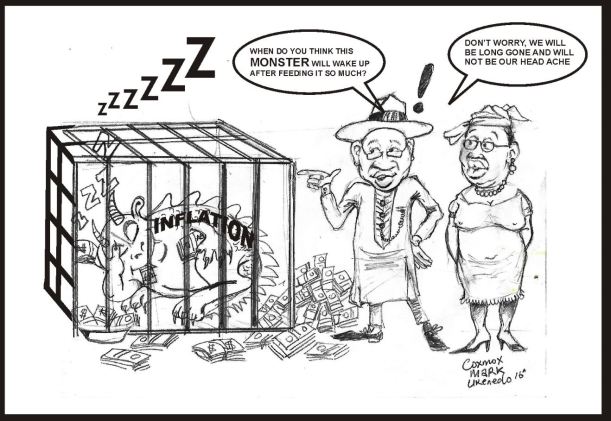
PIC. 1 BUHARI AND THE FIGHT AGAINST INFLATION.

Until we understand the realities of existing situations, explanations will continue to be mere stories. With global oil prices falling and the economy at a crossroad, the general believe and understanding is that President Buhari has refused to spend to move the economy forward, but until we understand the principles of his economic actions, we will fail to understand and appreciate the calamity the President is saving the nation from.

The President’s secrete war is nothing more than the fact that he is fighting for the soul of the Nigerian economy, he is fighting the monster called inflation, for if inflation is allowed to escape it will spell a major disaster for the economy, everything you own will lose its value and might become worthless. For those who do not understand, I will take the time to explain through this article, where the problem started from, the state of the economy, the present reality, and why we must brace ourselves for the hardship ahead to avoid total economic disaster and save the value of what we have and own.

First thing to Note:

It will interest you to note that despite the fall in oil price to over 100%, reduced external earnings, and the depreciation of the Naira at over 100% since 2014, inflation has only risen from 9.2% to 12.8% over the last one year.

Understanding the Genesis of Our Present Challenges:

“The First Panacea for a Mismanaged Nation is Inflation of the Currency: the Second is War. Both bring a Temporary Prosperity; Both Bring a Permanent Ruin. But both are the Refuge of Political and Economic Opportunists”………..Ernest Hemingway

At any given time a good government must know and regulate the amount of liquid cash within its economy, this will help regulate government expenditure, which is knowing when to inject money or withdraw money from the economy. Early year 2000 during President Obasanjo’s government, while the economy grew at an average of 8.92% and was at its potential, consumer spending as a percentage of GDP stood at an average of 24.5% from 1999 to 2009 (11 years), this was before rebasing the economy, the Nigerian Economy still operated with the USD$262.2 billion GDP, in essence consumer spending was an average of USD$64.3 billion. Note that consumer spending which is supposed to make up about 2/3 that is 70% of the economy or GDP was kept at 24.5% among the five factors that makes up the GDP, namely: Consumer spending, Investments, Government Spending, Export, and Import.

Why did Obasanjo do this?………to curb and prevent inflation, Nigeria lacks the necessary tools used in a developed economy to checkmate inflation when expanding an economy where money is injected in the form of stimulus, Nigeria is a liquid cash economy, everything is paid for in cash. When government uses fiscal policy to jump start or expand an economy by injecting money into the economy, interest rates is supposed to increase to discourage people from spending. In a developed economy which is mainly a credit system, interest rates charged on credit card is increased and the buying power of consumers is reduced and people spend less.

With increased government spending in the economy and people spending less, retailers, manufacturers, and service providers will find it difficult to increase their prices because the bargaining and buying power of the consumers have been reduced, hence they are forced to retain their existing prices. The other measure is increasing taxes to reduce the income of consumer thereby also reducing their buying power. While credit card reduces your spending on money you don’t have, taxes reduces the liquid cash you have, both ways you are forced to reduce spending.

Inflation in most cases are psychological, the more you know someone can pay for a good or services, the more you increase the prices, and when prices increases and people continually pay for them they keep on increasing, they rarely ever go back to the original position. It is easier to increase prices than reduce them, HENCE IT IS BETTER TO PREVENT INFLATION THAN TRYING TO SOLVE IT WHEN IT HAPPENS FOR YOU WILL WORK TEN TIMES HARDER AND THE PRICES MAY REDUCE BUT WILL NEVER RETURN TO IT’S ORIGINAL POSITIONS.

Between 2000 and 2009 the economy was at its potential growing at an average of 8.92% yearly, Obasanjo knew too well that pumping more money into the economy will push the economy beyond its potential and invite inflation, the president did the wisest thing…Save!…..by saving, you are reducing the buying power of the consumers and at the same time saving for the rainy days.

Ngozi Okonjo-Iweala, Goodluck Jonathan and the Illusions of a growing Economy……..

“Inflation is Everyone’s illusion of Wealth”……John Maynard Keynes

Ngozi Okonjo-Iweala, an economist, Harvard graduate, World Bank Vice President and Coordinating Minister of the Nigerian Economy under President Goodluck Jonathan, one would expect that as an economist from Harvard or a World Bank VP should know the simple economic principles of using fiscal policies to expand the economy, and to know that the Nigerian system lacks the tools to checkmate the excesses. While the economy was at its potential, the government continued to inject money creating an excess liquidity economy. Recently the former minister at an international function condemned the Jonathan government for not saving, but what she failed to tell the world was that she employed the wrong policies and failed to advise the government on the implications of excess liquidity in an economy.

In 2010, Nigeria’s consumer spending as a percentage of GDP had increased to 51.2% from an average of 24.4% between 1999 to 2009, increasing at over 100% within one year, at the same time our external earnings as a percentage of GDP from exports had reduced from 43.1% in 2006 to 25.3% in 2010, while our consumer spending was increasing our external earnings was reducing. Put in mind that at this time Nigeria was still operating the old GDP, so the consumer spending jumped to USD$134.2 billion. What this means in lay man’s terms is your take home pay or salary reduced by 50% and the expenditures within your household increased at over 100%. At this time there was so much liquid cash within the economy.

By 2013, Nigeria rebased her GDP and it was increased to USD$509 billion and by 2014, consumer spending had increased to 55.5% of the GDP, that is USD$282.5 billion and export earnings had further reduced to 18.4% as a percentage of GDP, USD$93.6 billion. President Jonathan and Okonjo-Iweala kept on pumping liquid cash into the economy without understanding the dangers of inflation in a liquid cash system………..what this means is that the economy was not really growing from productivity but growing from the injection of cash into the system which increased consumer spending and buying power.

The Problems and the unforeseen Disaster!…..

“Inflation is as violent as a mugger, as frightening as an armed robber and as deadly as a hit man”……Ronald Regan

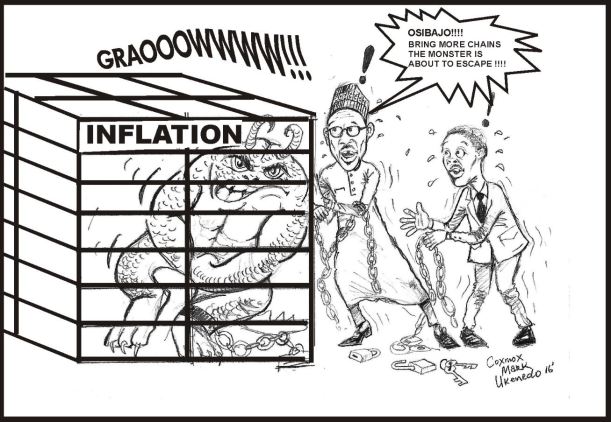
PIC. 6 BUHARI ANDTHE FIGHT AGAINST INFLATION

With the Nigerian economy still booming and government rebasing the GDP to the new official figure in 2013, Jonathan and Okonjo-Iweala continued to inject money into the economy, in 2014 being the year preceding the elections, government spending and corruption increased, the new disaster was not just the liquid cash that was being pumped into the economy…….oil prices started to fall!…and Naira depreciating.

As oil prices fell and the foreign reserve depleted, the only reasonable thing left for Jonathan and Okonjo-Iweala to do was to cut spending, rather they increased it, external earnings had dropped to 18.5% of GDP reducing the dollars earnings coming into the economy, consumer spending increased to 55.5% of GDP, liquidity in the economy was very high and the Naira had started losing its value, in an import dependent economy with no manufacturing and export capacity ………THE DEFINITION OF THIS IS HYPER-INFLATION.

Three factors fueled the economy with liquid cash:

  1. Government spending under the GEJ government: With the Nigerian economy being the third fastest growing economy in the world, government continued to pump money into it thereby overheating it.
  2. The monumental corruption under GEJ’s government: As people stole they invested in capital projects creating a multiplier effect of liquid cash within the economy.
  3. Politics: The Governorship, legislative and Presidential elections poured excessive cash into the system, in fact the presidential elections was characterized by large scale withdrawals of dollar reserve from banks distributed to people, traditional rulers, and support groups.

When there is inflation or government senses inflation, the first thing government should do is cut and tighten money supply into the economy, this will force prices to remain stable as there will be less money in circulation for people to spend or reducing the buying power of the people. Even the US has been known to practice this to avoid and bring down inflation, just recently fearing a perceived future inflation, the US Federal Reserve increased the interest rates, countries have been known to create recessions to help avoid inflation.

The economic principle of money supply is this……when government supplies money into the economy, people get richer, and as they get richer they can afford more imported goods, so import increases, as import increases it puts more demand on the dollars driving up the exchange rates. The second thing is, as money supply increases from government, people get richer and money demand from the people will also increase, why is this so?…….as you get richer your lifestyle changes, you will need more money to maintain and keep the lifestyle going. Example are all those who bought private jets under GEJ, they will need more money to maintain, service, pay the airport authority, tax will increase etc. and as money demand increases, liquidity within the economy increases.

Nigeria is an import dependent economy, we import everything from toothpicks to the refined petroleum products which we extract from crude, Okonjo-Iweala and Jonathan should have known that as the dollar reserve started to fall, prices of oil falling, depreciation of the Naira, and excess liquidity of cash within the economy that prices of imported goods will start to raise…….rather they turned a blind eye to it and continued to fuel the economy with cash till May 2015 when Jonathan left government….talk about Harvard, World Bank VP, and Coordinating Minister of the economy….competence was clearly lacking.

Buhari’s Actions, why he is shrinking the Economy!……the War on Corruption and the untold reality.

“Law of Inflation: Whatever goes up will go up some more”……..Anonymous

With the Naira devalued in the black market at over 100%, at present the Nigerian economy is at a state of being between the devil and the deep blue sea and the government must choose the lesser of the evils, if the government spends to jump start the economy it is obviously going to invite inflation because it will increase the buying power of the people and prices will increase, as prices increases inflation sets in, and if government refuses to spend, the hardship continues for a period of time and the economy slowly builds back to its potential.

What Buhari is basically doing is that he is shrinking the economy to avoid inflation, countries have been known to do this in the past to help avoid the monster from escaping, that’s why he is mopping up all the liquid cash within the economy and reducing the buying power of the people. Even with the fact that the Naira has lost over 100% of its value inflation has only risen by about 3 digits, if not for the presidents continued actions a loaf of bread would have been selling for about N1500 or more by now.

The continued war on corruption is not just because corruption is killing the economy, it is also to mop up all available cash that can circulate within the system, when people steal the first thing they do is embark on capital projects, these projects will obviously create a multiplier effect in the economy, hence it is also a disaster for the economy right now to have all the stolen billions working within the system.

PIC. 5 BUHARI AND THE FIGHT AGAINST INFLATION

In a developed economy, the way to shrink an economy is to reduce money supply, increase interest rates and in some cases increase taxes, but the Nigerian economy lacks some of these economic tools, hence the president is physically and manually mopping up the cash to avoid the catastrophe.

So for those who feel the president is not doing anything, you do not know the disaster he is fighting and preventing from occurring, you will not know unless you understand these principles in economics.

The Odds and why the Core Economic Models can’t Work in Nigeria……

The first principle in economics when a currency is devalued is that it should increase the export of that country, the disadvantage in devaluation becomes an advantage in export, the country will now be able to make more foreign exchange from exporting other goods and slowly build up its dollar reserve and currency value which eventually returns the economy back to its potential.

So the question here is what does Nigeria export?……NOTHING!…so the devaluation of the Naira is useless to the economy, so those clamouring for the total devaluation of the Naira saying the government should allow the market determine the price should know that it will further drive up prices and drive investors away…..nobody wants to put their money where they won’t know what the value will be tomorrow.

There are factors that could have helped push the Nigerian economy back to its potential leveraging on the devalued Naira, but the Nigerian economy has neither of the two.

Economies of countries are built around two models, either Comparative Advantage or Absolute Competitive Advantage. Comparative advantage which is coined from the word “Compare” is the product of efficiencies, cheap labour and low currency value, let’s take the United States and China, for example the United States might want to manufacture product X but it will cost them USD$2 billion because of the high value of the dollar and cost of labour, importing the same product from China might cost the United States USD$500 million, so rather than manufacture, the US will import these products from China and save USD$1.5 billion dollars.

In this situation China is said to have a comparative advantage over the United States, the major factors helping China here is their cheap labour and weaker currency. The weaker your currency the greater your comparative advantage, hence when a currency is being devalued the greater the export of a country because the cost of your goods become cheaper, a unit of the dollar can buy more units of your currency, that is why countries like China don’t want their currency to appreciate and are always said to be manipulating their currency value to keep it low.

The second is the Absolute Competitive Advantage, this is where a country is able to produce goods and services at a lower cost per unit using more efficient processes or technology, and it also includes having products or services which only the country can manufacture or render, Example is Technology in the US. The US has absolute competitive advantage when it comes to technology in some sectors and is able to export that to China while China buying these technologies have comparative advantage over the US, hence both are able to import from each other. Countries with absolute competitive advantage usually have stronger currencies.

Nigeria does not operate a credit system, most people are not accountable for their tax income hence it is almost impossible to regulate the goods and money market using these tools, it is therefore imperative for the government to employ economists who can think beyond the context of textbooks by tackling the economic challenges from the practical point of view using daily CPI to measure changes and the statistics of the five factors of GDP to make future forecasts.

Conclusions!……

AT THIS POINT IT IS EITHER WE SHRINK THE ECONOMY TO SAVE IT OR WE SPEND AND ALLOW IT EXPLODE IN THE FLAMES OF HYPER-INFLATION…..WE MUST AVOID THE ZIMBABWEAN SCENERIO WHERE $I TRILLION IS WRITTEN ON A BANK NOTE

Leave the economy and it will slowly build up and return to its potential, any excess spending will bring in inflation and destroy the value of the economy, it is a slow and painful process but it is the price we must pay for the reckless way the economy was managed under GEJ and Okonjo-Iweala.

Buhari must continue the intense fight on corruption, corruption has denied the country of its economic growth and it is the number one enemy of progress within an economy. Imagine if USD$200 billion dollars stolen from the Nigerian economy was working for us within the system…..remember in the multiplier effect, every USD$1 spent creates a multiplier effect of USD$5, in essence our GDP should have been well between USD$1.2 trillion to USD$1.5 trillion by now and Nigeria will be among 15 biggest economies of the world with investors’ confidence bringing in more investments to the country. But the irony is that corruption has robbed and denied us of these achievements.

The President also needs come out to enlighten the people to enable them know what the struggles and challenges are and why government needs to follow this economic path, he is fighting a good fight on behalf of the country and economy but most people don’t know or understand this hence they will assume the worst of things. During change, the people must be carried along to help enlighten and know the reason behind every strategic action, this will help prepare them for the hardship and struggles ahead when they know what to expect and every man can plan accordingly.


81 Comments

Naira versus the Dollar, Jonathan’s Policies as Buhari’s Challenges, the Simple Economic Principles, and the colossal Damage.

“Knowledge will forever govern ignorance; and a people who mean to be their own governors must arm themselves with the power which knowledge gives”. —— James Madison

Naira Vs. dollars


There are two basic principles that govern economics within an economy, for if you transgress on the first one you are bound to pay direly for your actions in the future.

  1. Do not spend but save and pay off your debt when the economy is at its potential and spend when the economy is below potential to bring it back to potential.
  2. Any policy, either fiscal or monetary taken by the government to push the economy back to its potential on the long run will not start to yield results until after 6 to 8 quarters, which is a year and a half to two years in a developed economy because they have less shocks and might take up to 12 quarters (3 years) or more in a developing economy because they have more shocks. Examples are inflations, exchange rate, civil unrest etc.

To understand these principles we will go back to history:

1999, Olusegun Obasanjo and his economic team

Obasanjo, was a president that understood economic principles and followed these core principles in managing the economy. Between 1990 and 1999, Nigeria’s economy only grew at 2% annually making it the worst economic period for the country, in 1999 when General Addulsalam handed power to OBJ, Nigeria had only USD$4 billion in its foreign reserve, but by the time OBJ left office we had USD$60 billion in the foreign reserve and another USD$40 billion in the Excess crude oil account.. OBJ and his economic team through their economic policies decided to diversify the economy moving it away from the mineral resource sector. Overnight, Nigeria’s economy grew shifting from below potential to potential and grew at annual average of 8.92% between year 2000 and 2009, Nigerian’s economic growth was only next to China and India in the world.

Obasanjo did the most sensible thing any good leader would do, following the core economic principles which may not be popular to the people, Obasanjo decided to save and pay off our foreign debt rather than spend. The effect of this is that you have money to spend to push the economy back to its potential when the economy is not doing well or below potential, and the second thing is having reduced or paid off your debt, majority of the money will go into capital expenditures in the form of stimulus to jump start the economy rather than using it to service debts.

With the economy growing and at its potential, had OBJ decided to push money into the economy through government spending, it would have only resulted to pushing the economy beyond its potential, heating up the economy and causing inflation. Not only will it cause inflation, so much money in circulation increases the wealth of the people overnight, when people get richer, export tends to reduce and import increases because they are able to afford more of foreign goods, this puts a strain on the dollar reserve of the country increasing the value of the dollars against the Naira and will ultimately lead to an increase in negative balance of payment for the government in international trade as Nigeria is not even an exporting nation.

The Effects of Obasanjo’s Policies

Most major governments coming out of economic woes do not enjoy the positive effects of their sound policies, it was actually about after 4 to 5 years later that we started to experience the positive effects of OBJ’s economic policies.

Soludo as economic adviser and later CBN governor was able to drive his economic goals using monetary policies, when Soludo became CBN governor, dollar was N147 and by the time he was leaving, the dollar had reduced to N117, gaining a value of N30 against the dollar.

Nigeria had USD$100 billion between the Foreign reserve and the Excess crude oil account and in 2008 when there was a global recession and the economy fell below potential, Nigeria had enough foreign reserve to keep the economy growing. Nigeria had paid off majority of its loan which meant during recessions we can spend more on capital projects as stimulus and reduce expenditures for servicing debts.

Was Obasanjo’s policies the most popular among the people?….obviously no, but it was the best for the economy, most politicians who follow the core economic principles are never popular because people always want more money to spend which creates a future negative effect for the economy like what we are facing today.

Every economic boom enjoyed by the Jonathan administration was the hard work of his once political godfather OBJ and his economic team. Basically what OBJ had done was to take care of the macroeconomic problems of the country, the Naira was very stable, there was confidence in the economy and Foreign Direct Investments poured into Nigeria. Had OBJ employed the wrong economic policies before leaving office, and the policies taking about 3 to 4 years to see the effects, Jonathan would have been the one to suffer it, but OBJ stayed true to the cause of a sound and solid economic policy till he left office.

All major changes require between 5 to 10 years to reach the goal depending on the magnitude of the change, and one of the greatest reasons change efforts fail is because the successor does not either understand the change or does not have the same mission, vision and drive to implement the change. This is why most leaders choose their successors to complete whatever they have started since time does not permit them in office to drive the change to completion.

Jonathan, the opposite of economics and the beginning of our economic woes.

Like the proverbial prodigal son who inherits wealth from his father and without challenge to build on it to continue the legacy of the father but squanders it, Jonathan employed the direct opposite of economic principles with the help of Ngozi Okonjo-Iweala as minister of the coordinating economy. They spent and borrowed more when the economy was at its potential leaving the economy vulnerable during recession. While the ignorant Nigerians hailed her as coming from the World Bank and better suited for the job, the question remains whether it was her influence that was employed or her capabilities. Someone who claims to have worked with the World Bank and has risen to the position of Managing Director should know these simple economic principles.

In 2010, Lamido Sanusi Lamido, sounded a note of warnings that the Jonathan Administration was depleting the foreign reserve and that if we faced a recession or drop in oil prices it might spell disaster for the economy. This put the Jonathan administration on a lock horn with Sanusi and seeing Sanusi as someone who will not keep quiet switched over to spending the dollars in the Excess crude oil account.

When the governors found out that the Excess crude oil account was being tampered with by the Executive, took the executive to court and  demanding that the money be shared rather than Jonathan and his cronies spending it. That was how the USD$40 billion left in the Excess crude account by OBJ was wasted. While the administration sold crude at an average price of about USD$110 per barrel for five years it never saved a dime but rather depleted everything the OBJ government had built on ground.

OBJ and his team clearly balanced the five factors of the GDP while the economy grew, he refused to push excess money into the economy, and this was clearly shown from the percentage of the service sector to GDP. In 1999 it was 26.8% and increased to 28.7% in 2009, it stayed at an average of 24.5% in 11 years, from 1999 to 2009, by 2010, our services as a percentage of GDP had increased to 51.2% over 100% increment, while the GDP grew by only 7.8%. Services had increased to 55.5% by 2014 with an average of 52.3% in 5 years from 2010 to 2014, still recording over a 100% increment while the GDP had not increased more than 28.7% over that same period.

The more money injected into the economy, the more consumer spending increases and the more the services increases, what this clearly means is that the economy was not expanding but consumer spending was increasing, our external earning was not increasing but internal spending was increasing, our revenue from export was decreasing while we spent everything we earned.

Percentage of our exports to GDP in 2001 was 45.4%, by 2006 it was 43.1%, 2010 it had further reduced to 25.3%, put in mind that our GDP and services was increasing while our external revenue earning was decreasing, by 2013 it had reduced to 18.0% and 18.4% by 2014. What is means is that our GDP growth was being fueled by too much liquidity within the system, all the money that should be in the foreign reserve was being spent in the economy thereby increasing consumer spending and the demand on the dollar.

Prior to 2003 before she was employed by the OBJ administration, Okonjo-Iweala was Vice-President and Corporate Secretary of the World Bank Groups, her job description was not that of a core banker or economist but more of compliance and due diligence. It is obvious that while she may wield the influence, the core capabilities are not there and this could be the reason after OBJ paid and renegotiated the loan arrangement for Nigeria, she was moved to the external affairs ministry from which she later resigned only to come back and plunge us into an economic disaster. Soludo was to confirm this in his open letter that most of the technical requirements and capabilities needed for the loan payments and renegotiations was handled by himself and the CBN and not Okonjo-Iweala as everyone had believed.

Why Politicians follow the Political Economic Decisions

While the core economic principles make politician seem as if they are doing nothing but it is indeed the best and most effective way to run the economy, the reasons they make counter decisions are as follows:

  1. They want to look good in the eyes of the populace despite the fact that their political economic decisions will have a long term negative effect which might start to materialise after 3 years. Such dire economic decisions are mostly taken when elections are around the corner.
  2. Stealing is the second reason politicians follow political economic decisions, they can’t just go into the vault and take money so they steal through over inflated projects, creating abandoned projects since the projects were not the aim in the first place. So when you see politicians embarking on massive projects during election period while the economy is booming, be sure to know that the project is not the aim.

Buhari, his Many Challenges, and the Sad truth.

As mentioned earlier, economic policies in a developing economy takes about 12 quarters (3 years) for you to start feeling either the negative or positive impact of the policies. Whatever we are suffering today are the consequences of the policies of the 2010 to 2014.

Whatever policies Buhari and his team have put on ground will not have its effects until the next three years minimum, that is just the economic truth, when OBJ started his economic policies after inheriting all the mess from the military era, it took about 5 years before we started seeing the positive effects of his policies, that’s just the way it works in economics. For those who are asking for the dividends of change, his change policies are what will lead to the goal.

There are still tougher times ahead and it is the obvious truth, in 2008 when the global recession hit Nigeria, the country had money in the foreign reserve, this clearly helped the economy as the government of Umaru Musa Yar Adua had money to inject into the economy as stimulus. When the economy is at recession or below potential as it is right now, government injects money into the economy through government spending on capital projects which acts as stimulus creating a multiplier effect in the economy. But the sad truth now is that Nigeria does not have such money  hence jump starting the economy will be a herculean task for Buhari as oil prices have equally dwindled reducing Nigeria’s external earnings.

Of Change and the Expected Miracles

“There is nothing more difficult to carry out, nor more doubtful of success, nor more dangerous to handle, than to initiate a new order of things. For the reformer has enemies in all those who profit by the old order, and only lukewarm defenders in all those who profit by the new” – Niccolo Machiavelli

For those who ask and are expecting the result as if it is the change, you must pause and find out what the meaning of change is, they think and expect that the change is an end itself, almost as a noun, change is a verb, and it is the process in which you reach your goal and aspiration.

The goal is the goal but change is what helps you reach your goal, it is a continuum. A fat person that weighs 200kg and wants to reduce to 80kg, change is not reducing to 80kg, the goal is reducing to 80kg but change is to stop eating junk food, stop ice cream, go to the gym and exercise, that is the change that will help you shed the weight and you reach your goal of 80kg.

Buhari is instituting and driving the change, it is the change that will get Nigeria to her feet again, he is curbing corruption, plugging the loopholes, it is no longer business as usual, people are made to return stolen funds, EFCC has woken up and those who thought they could not be touched are now going to court in handcuffs, the Nigerian Customs are now generating more money and becoming accountable. We cannot totally wipe out corruption but it will be greatly reduced because people are starting to fear the consequences of their actions and they know they can’t continue to steal with impunity.

These are the change we voted for and if it continues this way we will build a better Nigeria and reach our goal, the goal still remains the goal, but CHANGE the process which we will achieve it. Buhari will obviously make mistakes, but with his integrity we will keep to the course.

People are not happy because during Jonathans time there was so much money in circulation and most people spent like there was no tomorrow, the political economic decisions are those that are popular among the people, but what they don’t see is that it is a short solution to a long term economic consequences.

Nigerians and the Chinese became the highest purchasers of private jets in the world, while that of China could be explained economically, we could not explain the rationale behind that of Nigeria, but we are all suffering the consequences today, what seem good to the people at that time was a future economic disaster.

Nothing in all the world is more dangerous than sincere ignorance”…………Martin Luther King Jr.


3 Comments

The Future of Crude Oil, Saudi Aramco the World’s Richest Oil Company Proposes an IPO, and what the NNPC can learn from the move.

The Future of Crude Oil, Saudi Aramco the World’s Richest Oil Company Proposes an IPO, and what the NNPC can learn from the move.

Last week Saudi Arabia hinted the world that it might be taking Saudi Aramco, the state owned Oil Company and the richest oil company in the world generating more USD$1 billion a day to the stock market to float an IPO.

PIC. 18

So why is Saudi Arabia proposing to float an IPO in the States owned oil company said to be the most secretive company in the world worth trillions of dollars. The country is obviously the biggest player in the global oil market, a strategic ally of the United States and most favoured oil market for the United States with insider information and assurance on oil purchase. Founded in 1933, Saudi Aramco popularly known as Aramco is a Saudi Arabian national petroleum and natural gas Company based in Dhahran, Saudi Arabia, the story is that of discovery and development of the greatest energy reserves the world has ever known and the rapid transformation of Saudi Arabia from the desert kingdom to modern nation state.

For years Saudi Arabia has always protected its share of the global oil trade even if it means not cutting down on production to increase market price when prices fall in the international market. It is becoming clearer and clearer by the day that crude may never hit the 3 digit figure again……obviously not for years to come and not looking elsewhere for foreign earnings will spell doom for the kingdom and a serious threat to its monarchy.

The richest and the most secretive company in the world has woken up to the fact that going public and retracting the economy may be the only way out of their present situation, they have woken up and seen the market dangers ahead and their corporate survival will depend on a new strategy. The shift in environmental and resources strategies has ultimately forced the Saudis to consider new strategies of survival as the old strategy can no longer be sustainable.

When the lead global player holding the largest reserve of crude oil in the world decides to take a bold step and change directions, then the world should know and read meanings to this strategic move that the future of crude might never be the same again.

Living in Opulence!

With a population of about 28 million people and a GDP of USD$746.2 Billion and the 19th largest economy in the world with an average GDP growth of 3.8%, Saudi Arabia has one of the highest GDP per capita in the world with a figure of USD$24,161 boasting of a whopping 16% of the world’s total petroleum reserve.

Saudi Arabia is the largest exporter of crude oil with the petroleum sector accounting for 80% of its budget revenue, 45% of GDP, and 90% of export earnings. As of 2014, Saudi Arabia had a labour force of 11.22 million people with 80% of its labour force as non-nationals, which means of this number, 8.98 million are foreigners working in Saudi Arabia and only 2.3 million of Saudi nationals about 8% of the population actually works, with the government being the employer of majority of the working population. Everything is subsidized in Saudi Arabia, from food to petrol, to electricity, water and education, which eventually has its burden on the economy.

The Problem!

With a sluggish economy built around crude oil and holding a strategic alliance with the United States in crude sales, the global oil sales can best be described as a global chess game where every move is geared towards killing the queen which in this case represents the price. Oil prices have collapsed by 65% from about a year and a half ago, while this has created a positive outcome for the American consumers because of the reduced pump gas price, it has thrown countries like Saudi Arabia, Nigeria, Brazil, Venezuela, Russia and Iraq into economic chaos. With the end of sanctions in Iran, it will further add a devastating blow to the dwindling oil price, China which is the world’s second largest economy and world largest importer of crude oil has also seen a slowdown in its economy which has further reduced the demand for crude in the international market, and hence the supply now heavily outweighs demand.

The fall in the global demand and price created a budget deficit of 15% of the GDP for the Saudi Arabia in 2015 of about USD$98 billion with a total deficit standing at USD$100 billion. Though having a USD$650 billion in its foreign reserve, the IMF warns that the country could run out of money within 5 years if it does not tighten its expenditures and find new ways of raising money.

So what’s the Plan?

With the fear that crude prices may never hit USD$100 again, the Saudi’s have acknowledged that the economy must change, and people have to be made to work rather than living in opulence and putting the burden on the state. Prince Muhammed bin Salman, the powerful prince and son of the King has that the first stage of the blue print will be for fiscal consolidation to help eliminate the budget deficit.

Floating of IPO in Saudi Aramco, the national icon and the world’s most valuable company which will allow the Saudis to open its books to the world, this will help the Saudi nationals know exactly how much Aramco make in profit yearly which has always been a center of debate on the Royals expenditure.

Increase prices of petrol, electricity and water which is still heavily subsidized, new taxes of 5% VAT, introduction of SIN taxes, diversify from the oil boom by boosting private business and introducing market driven efficiencies, getting the state out of all but its essential functions from health and education to state own companies, privatization and private provisions of public services, complete or partial privatization of dozen agencies and state own companies including national airlines, Telecoms, and power generation.

The Future of oil!

One of the political and economic reasons why the global oil price has plunged from USD$110 in 2014 to a record low of about USD$30 is because the Saudis are determined to protect their share of the global oil trade. Ordinarily, applying the laws of demand and supply, oil producing countries were supposed to cut down on supply to maintain an appreciable market price, but the politics of protecting market share and the fear of losing such market share if the prices increase has made countries like Saudi Arabia continue to produce at normal capacity.

The country enjoyed a budget surplus in the past from the oil boom which has been slowing down lately and creating a budget deficit, in 2006, there was a budget surplus of 19.9% of the GDP, 29.8% in 2008, 11.6% in 2011, and 13.6% in 2012. There was budget deficit of 5.38% in 2009, 2.3% in 2014, and a whopping 15% in 2015. Revenue this year is expected at USD$137.1 billion down from USD$162.2 billion in 2015 further creating a budget deficit if appropriate measures are not put in place.

NNPC and the Nigeria’s oil Future!

The Nigerian government must start to come to terms with the fact that the future of oil may be coming to an end and must start looking for alternatives in generating funds for the country. Though the sale of oil will continue but at low prices with an uncertain future which might not be sustainable for the income that will be required to run the economy. It is becoming clearer by the day that you cannot project the growth of your economy and the projected income on a resource that is a buyers market.

Following the example of the proposed IPO by Saudi Government, NNPC should make every effort to go public and raise money through an IPO which will help the Nigerian State owned company raise money and be better managed. With a long history of corruption, going public, the NNPC will be better accountable to the people and government and it be difficult for corrupt government officials who may want to use the agency as their cash cow at the detriment of the state. Going public at this time will obviously help with increased prestige and visibility, improving its financial conditions and build a better trust between the NNPC and the Nigerian people.

With a bleak future price of oil, government should start to reconsider its strategy of the control of the NNPC which might no longer be sustainable on the long run for the economy.


Leave a comment

Leadership, accountability, and the strategic role of followership……………..

Leadership, accountability, and the strategic role of followership……………..

“People shouldn’t be afraid of their government. Government should be afraid of their people”—–Alan Moore, British Author.

Africa, the second largest and second most populous continent, one-third (33.3%) of the world’s mineral reserve lies in Africa, two-third (66.6%) of global diamonds comes from Africa, the continent holds one-tenth (10%) of the global oil reserve. Africa is home to some of the rarest mineral resources in the world, the Uranium used in the atomic bomb on Hiroshima and Nagasaki was mined from the Democratic Republic of Congo as far back as 1944, the mineral Cobalt used in space shuttle flight is mined in large quantities from the Democratic Republic of Congo, the mineral Coltan used in cell phones and electronic products is mined from the Democratic Republic of Congo.

There are seven continents, arguably Africa can be said to be the richest of the six liveable ones, as at March 2013, the World Bank identified Africa as the poorest continent. In 2013, Africa was the world’s fastest growing continent with 5.6% growth in its GDP and expected to grow at an average of 6% from year 2013 to 2023. Africa has recorded growth throughout the continent and over one-third of Sub-Saharan Africa growing at 6% or higher. It is expected that with the current growth rate most of African countries will reach middle income status of USD$1,000 per year by 2025.

Apart from the rich and abundant mineral resources, of the 7.2 billion world population, Africa is home to 1.136 billion people. In 1950 with world population of 2.53 billion, Africa had just a mere 228.8 million people representing 9% of world population then, it has recorded an internal growth of 396% in 65 years which is an addition 907.2 million people making up 15.7% of the world population as at 2015, it was also the fastest growing continent in terms of populations. Europe with a population of 549 million and 22% of world population in 1950 and almost twice the population of Africa has only been able to add 194.1 million people in 65 years increasing the population to 743.1 million, a growth of just 35%.

In 1950, the population of Latin America and the Caribbean was 167.4 million and is 630 million as of 2015, an increment of 276% over 65 years, North America at 171.6 million in 1950 increased to 357 million as of 2015, recording 108% in 65%. The two continents of South and North America made up 13% of world populations in 1950. Asia had a population of 1.4 billion people in 1950 representing 55% of the world population then, it has grown to 4.4 billion in 2015 an addition of 3 billion people, 214% internal growth.

With an abundance of mineral and human resources, Africa has a working age group of 527 million which is expected to reach 800 million by 2030, it then means it is a continent with huge cheap labour potentials with average labour rate between USD$90 to USD$180 per month. So what is the excuse, challenges and problems that has continued to plague Africa and cease the continent from taking its rightful place on the global map? The most valuable of all resources any country or continent should boast of is its human resources which Africa seems to have in abundance. It is estimated that Africa will have a combined population of 2.4 billion people by 2050 of the projected 9.3 million world population and will represent 25% of global population while that of Asia will decrease to 54% from 61% in year 2000, Americas will represent 13%, and Europe 7%.

Investing in its population, Africa should be a power house of industries and manufacturing, the Asians and Latin America has been able to harness these potentials and have placed themselves on the road of industrialization by using the strength of population. For a people to have a sense of constructive followership they must have a strong, honest, purposeful, and inspiring leadership that will drive the moral of the people, it must be a leadership backed by actions that inspire others to dream more, to learn more, do more and become more as stated by John Quincy Adams, the sixth President Of The United States. The obvious truth is that Africa has not had good leadership, it is a continent that has been devoid of direction of what and where its goals and objectives should be, what it intends to do with the vast mineral and human resources at its disposal. Africa lacks accountability from its leadership and the people have never really been seen as people asking for it, they are more concerned about the present than a country and continent they will leave for the future generations.

Former South African President Thabo Mbeki in May 2015 while addressing Pan-African Parliament as the current chairperson on the High Level Panel (HLP) on the Illicit Financial Flows from Africa, his panel’s report had estimated that between USD$50 to USD$80 billion is stolen from Africa yearly by foreign firms through tax avoidance and fraud and this has cost the continent an estimated USD$1.4 trillion in illicit financial outflows in the last three decades perpetrated by foreign corporations and corrupt Africans.

Like a successful firm, every leader must know what its cash cow is and how to use the proceeds to develop other aspects of the business SBUs to generate greater profit for the company. Africa has its mineral resources as its cash cow but has failed to invest the proceeds to build a better society by empowering the people. Mao Zedong, China’s great revolutionary leader saw the power and potential of great number of population and positioned China by instilling work ethics and discipline to later become the world manufacturing powerhouse and industrial super power.

Nigeria, the classical example:

With a population of about 178 million, Nigeria is Africa’s most populous country and 8th in the world with a 2.5% annual growth rate. One in every six African is a Nigerian, it is the largest exporter of crude oil in Africa and has the largest natural gas reserve in the continent. Nigeria with her newly rebased GDP in 2013 became the 26th largest economy in the world and the biggest in Africa and at the close of year 2014 the GDP was estimated at USD$568.5 billion. It is estimated that the population will reach 440 million by 2050 and will make Nigeria the third most populous country after China and India, this will put Nigeria on the foremost centre of cheap labour in the world.

The biggest resources of the country is in its untapped human resources, yet the government has not seen it deem fit to develop this sector. The citizens themselves do not ask for more than they get because they have not been able to develop a strategic road map on how to hold government and public officials accountable for the dividends of governance and democracy. Nigeria is the only country where a governor of a state will go with an entourage and media coverage to commission a borehole of about USD$1,000 for a community while spending over USD$10,000 on itinerant and media coverage. The wastage and not being accountable to anyone has developed into impunity which the ordinary populace do not dare to question for fear of retributions.

Great societies are not only built by great leaders but also through the principles of good followers.

General Dwight David Eisenhower, the 34th President of The United States, during his time as Supreme Commander of the Allied Forces that liberated Europe during World War II had made it clear that every unit of the arm forces had their role to play for the strategy put in place to defeat the Germans to be successful, no components of strategy works in isolation, the components must support and reinforce one another, for any strategy to succeed all its components must play complementary roles. The goals of the strategy must be defined, what products or services we are introducing to achieve these goals, what are the core activities that has to be performed and what value proposition are we giving to the society.

The strategy of building a great society does not only lie with leadership, the populace is a part of the strategy and if the populace refuses to play its strategic roles then the strategy is doomed to fail. The society must play over 50% of the core activities of making sure leadership works, for leadership will continue to fail if a society does not ask for greater standards and services to the people through accountability. A society that does not “Demand” the best from its leaders is a society fed with crumbs and leftovers, Nigerians have consistently allowed the leaders get away with impunity, they have over the years disenfranchised themselves from the active politics and resigned to faith that the Almighty God will one day come down to fight their battle while not knowing that the power of governance rests within their hands.

The best societies of the world today are those whose people used the ballot boxes to ask for accountability, they confronted the leadership when they perceive or know the interest of the greater society is not taken into account in leadership decisions, they bring the economy to a halt through protects and strike and they ask that justice must be served to those who have in one way or the or other robbed the system or broken the laws of corporate governance and ethics. It is through these processes that the populace can play strategic roles in shaping and demanding for accountability from leadership.

Most Nigerians don’t even know their rights, Nigerians have come to accept their rights as privileges because they have refused to demand for the right in the first place. Nigerians jubilate when a governor commissions a borehole for a community. For example, the populace can fight the jumbo pay of legislators by using their power of electorate, most Nigerians don’t know that a serving Senator or House of Representative member can be recalled. Within the 1999 Constitution of the Federal Republic of Nigeria, Chapter V, Part 1, Section 69, Sub-Section (a), on National Assembly it states:

National Assembly

 69. A member of the Senate or of the House Representatives may be recalled as such a member if –

 (a) “there is presented to the Chairman of the Independent National Electoral Commission a petition in that behalf signed by more than one-half of the persons registered to vote in that member’s constituency alleging their loss of confidence in that member”.

These are amongst the strategy that the populace can use in demanding for better governance and accountability from the government. The people must wake up and demand for accountability from the Executive, Legislative, and Judiciary both from the Federal and State level. The strategic ways the follower follow is as important to the success of governance as how the leaders equally lead, it is a complementary strategy of holding one another accountable for the deliverables expected from governance and the output expected from the investments of government on the people and society.

Nigerians must understand that the society has a great role in shaping good governance which can be compared to the same objectives of the actions of civil society in Global Governance. These roles must include strategies to promote a set of values that must demand from leadership: accountability, transparency, responsiveness, equitability, inclusiveness, efficiency, rule of law, participation and consensus oriented decisions.

Nigerians as a civil society can adopt the following measures in making sure that government and leaders are accountable to the society:


  • Demand for Increasing Public Transparency of Governments Operations: The civil society should demand for an open government which will include projects of open data, e-participation, accountability and public contracting Websites.


  • Monitoring and Reviewing Policies: The civil society must play the role of a watchdog to oversee policy formulation and implementation, reports must be studied, criticized and not just accepted, and must be ready to challenge the failure of ongoing policies.


  • Seeking Redress for Mistakes and harms attributable to Regulatory Bodies: must be ready to drive norm change, official impeachment, reparation paid, institution reconstructed. The rights of the civil society can be exerted through to auditors, ombudsman, and legislative arm of government, courts, and the mass media. 


  • Advancing the Creation of Formal Accountability Mechanism for Governance: The Civil society must encourage government discussions, need to strengthen mechanism of accountability by leveraging social media, public consultations and public events in which national agencies are accountable for what they plan with the budget and what they really do and how.


 The society as followers must acknowledge that to enforce accountability and good governance from the leaders the followers must play an important role in shaping a minimum standard required from leadership, in the same way leadership without direction and followers that cannot hold the leadership accountable results in disaster for the civil society, and for the followers to be able to demand accountability and good governance from leadership, the followers must exhibit the following qualities:


  • Good Sense of Judgement: Even as followers take directions from the leadership of the society, they must have an underlying obligation to the society and country to do so only when the direction is ethical and proper. Followers must know the difference between directives given by a leader which they do not agree with and one that is truly wrong. Good judgement is critical to being a good leader but it is also as equally important in being the follower. 


  • Education and Awareness: The civil society must be educated and aware of the task before them, people must be educated and aware of the task before them, they must understand and know their rights to fight for them, the awareness of policies and decisions in governance must be known, and to hold leadership accountable a fair knowledge of how things are done must be known.


  • Honesty: When followers feel that the leaders’ agenda is flawed or not in the best interest of the society, followers must owe leadership an honest and forthright assessment what the leadership is trying to achieve and how. Good leadership are appreciative of constructive feedback.


  • Show of Courage: Winston Churchill called courage “The Foremost of the virtues, for upon it all others depend”. Followers need to be honest with leadership and it takes courage to be honest. It takes courage to confront leadership about accountability and governance, hence it takes real courage to be a good follower.


  • Loyalty to the Course: Good followers must remain loyal to the course and must not be swayed by religion, ethnicity or tribal sentiments, they must be seen as people demanding accountability for the greater good of the society at large and not for a specific section, tribe or religion of people.


  • Ego Management: Good followers demanding accountability must know that it is not about them but about the greater good of the society so they must be ready to put any personal interest aside that might jeopardize the common interest of the society.


Leadership will always overshadow the followers but there are no leadership without followership, Nigerians must be ready to ask and demand for accountability if they want to make the society a better place. Followers play a critical role in shaping good governance through accountability by asking for increasing public transparency of governance operations, by monitoring and reviewing policies, by seeking redress for mistakes and harms attributable to regulatory bodies. These will be achieved through mechanism and strategies like demanding for accountability, advocacy, public education activities, fueling political debates, and show of courage to confront wrong decisions.


Leave a comment

When a leader fails to interpret the economic data of reality

When a leader fails to interpret the economic data of reality

When a man does not understand the fundamentals of economics and management he can never make sense of the disaster trailing his pocket, and that was the sad story of GEJ and his administration….he was a leader that didn’t understand and know the fundamentals of power of statistics in economics. With a recent interview at the National Democratic Institute in The United States of America on Tanzania and Nigeria, while trying to exonerate himself and his administration from corruption, it clearly showed that the past president still does not understand the fundamentals of the nation’s economy.

With Data and statistics you can always measure everything and speak with facts!…

Yes there have been corruption in Nigeria in the past but no regime or government has been so callous to destroy what was on ground and the opportunities afforded at a particular time.

Let’s go back!….

In 1980 Nigeria’s GDP was just USD$64.2 billion, by 1990 the GDP was rebased and the new official GDP was USD$262.6 Billion. This was a stunning 309% increase over 10 years with an annual average of 30.9% increments. Between 1990 and 1999 the economy only grew at an average of 2% per year making it the most stagnant period after the economic growth of Nigeria between 1980 and 1990. What we suffered during this period was the consequences of the wasteful years of IBB and his economic woes.

In 1999 when Gen. Abdulsalam handed over power to President Olusegun Obasanjo there was only USD$4 billion in the Foreign reserve, between 1999 to 2007 when OBJ left, he had built up the foreign reserve to USD$60 Billion and leaving another USD$40 Billion in the Excess crude oil account. So in essence between the foreign reserve and the Excess crude oil account, Nigeria had USD$100 Billion.

Remember that within this period too, OBJ through his Economic team was able to pay off The London Club and Paris Club debts.

By 2013, Nigeria once again rebased her GDP and the new figure was USD$509 Billion which meant the economy grew by 94% in 13 years, with an annual average growth of 7.2% surpassing the world average. In fact Nigeria’s economic growth was only third next to China and India….

Between 2003 and 2004 the economy grew at an average of 10% when Nigeria introduced the GSM phone earlier and its subsequent expansions and the massive concentration of the economy in the service sector.

Note:

OBJ concentrated the efforts of his administration on the Macroeconomics sector…..that is: by shoring up our dollar reserve, paying off our foreign debts and diversifying the economy from the resource sector to the service sector we can reduce the rate of the dollars before concentrating on the microeconomics sector.

The Microeconomics sector will need the reduced rate of the dollars to develop because it will have to import the various machines and equipment it would need for small scale industries to start operating.This was clearly shown in the dollar rate then, when Soludo assumed office the Naira was N147 to the dollar and by the time he left office with all the Macroeconomics they had solved the Naira had reduced to N117 which was a massive plus for the microeconomics sector.

When GEJ came into government, he was able to sell crude at an average price of USD$110 per barrel for 5 years with the budget pegged at USD$76 per barrel which meant more than doubled the profits Nigeria was earning from crude sales.

THE BAFFLING QUESTIONS:

OBJ’S years in office was marred by corruption which he tried to cub….but OBJ was able to do those things that he did despite the fact that crude oil was not that expensive then, so where did all the money go?……

In 2014, Federal Inland Revenue Service (FIRS) generated about N4.6 Trillion and the Nigerian Customs about N1 Trillion, between the Nigerian Customs and FIRS Nigeria generated about N5.7 Trillion yet our Budget for the year was N4.6 Trillion, leaving us with N1 Trillion budget surplus.

In the same year, on OPEC website Nigeria sold Crude oil worth about USD$90 billion and using the equivalent of the Naira value then will give us about N13.9 Trillion. So between the NNPC crude sales, the FIRS and the Nigerian Customs, Nigeria generated about N20 trillion in 2014 alone….other ministries and government agencies that generate revenues have not been added.

If the resources were well utilized during GEJ’s years we won’t be in this mess today!….Prof. Charles Soludo once wrote that within the GEJ’s years the Foreign reserve should have hit between US$120 to USD$ 130 Billion and the Naira Value increased against the dollar to about N70 to N80 if the economy was well managed and that’s the absolute truth. And he went on to say about N30 trillion had been wasted under the GEJ administration, only those who know how to read figures and economic trends will understand his theory.

When GEJ left office Nigeria had barely USD$ 35 billion in the Foreign reserve with all the money in Excess crude oil account gone!…… If the economy had been better managed we will not be suffering what we are going through today……Sanusi Lamido Sanusi clearly warned of the dangers ahead in 2010 when they started depleting the foreign reserve.

Exactly how IBB destroyed the economy in the 80’s when the economy grew at an average of 30% per year between 1980 and 1990 and the consequences of the after effect of what we suffered in the 90’s is resurfacing again because of the carelessness of one man!……..


3 Comments

Brace yourself……….2016 will be tougher!

Brace yourself……….2016 will be tougher!

The Nigerian Naira has been on a free fall lately and the CBN not able to do anything about it, at a point it even hit N280 to a dollar with a lot of Nigerians complaining and blaming the new government, the economic reality of world events shows that the increasing strength of the dollar is not peculiar to Nigeria alone and the world may be bracing for a tougher 2016.


In 2014, with the fall in oil prices, the International Monetary Fund (IMF) reduced its prediction for the world economic growth for 2015 from an estimated 3.8% to 3.5%, a reduction of .3% in total world GDP with Nigeria’s GDP growth reducing from the initial 7.3% projected growth to 4.8%, a reduction of 2.5% and was still the third highest only next to China at 6.8% and India at 6.3% growth and compared to South Africa, Africa’s second biggest economy which grew by only 2.1%. This meant that despite the fall in global oil prices, Nigerian’s economy was still projected to do well above world average, Nigeria was seen as Africa’s engine of growth.

Sub-Saharan Africa’s GDP was projected to grow at 5.8% through 2015 from 5.1% in 2014 surpassing that of the world average and only next to that of emerging and developing Asia that was projected to grow at 6.6%. The European Union projected to grow at 1.8%, Latin America and the Caribbean at 2.2%, Middle East, North Africa, Afghanistan, and Pakistan at 3.9%, with the United States and Canada at 2%.

The Bad News!…….

At the closing end of 2015, the world GDP did not meet the reduced adjusted figure of 3.5%, in fact the world GDP grew by 3.3% and it is project amidst all the global economic chaos to reduce further in 2016 with a projected growth of 2.7% with Sub-Saharan Africa reducing from 5.8% growth in 2015 to 3.5% growth in 2016, this means that the economy of Sub-Saharan Africa will shrink by a whopping 2.3% in revenue and the world as a whole shrink by 0.6% in growth. Apart from America in 2016, the forecast is that the year will be another year of repair, recovery, reform and risk for most countries. (The Economist, 2015)

The Federal Reserve of United States has been speculating that it would increase interest rate for some time, it finally confirmed this last week and further driving up the value of the US dollars in the international market. Why this is so: A strong economy will attract investment from all over the world due to the perceived safety and the ability to achieve an acceptable rate of return on investment coupled with low inflation rate. So the increase in interest rate will cause a massive flow of dollars back into the US economy with corporations, multinational and individuals buying up dollars worldwide to re-invest in the US economy causing disruption in demand and supply of the dollar in the international and local markets.

The second factor is the fall in global oil prices which has also reduced the amount of petro-dollars for oil producing countries like Nigeria, Saudi Arabia and Brazil. With less dollars now coming into these economies and corporations and multinationals moving money back to re-invest into the US due to increase in interest rates, most economies that depend on the petro-dollars as their main source of foreign exchange will face serious challenges in 2016.

The Signs are here!……….

Saudi Arabia……..Saudi Arabia hikes petrol prices by 40% at the pump

With a fall of more than 60% in global oil prices since mid-2014 to below USD$40 a barrel, Saudi Arabia is facing its biggest budget deficit in history of USD$90 billion, the government of Saudi Arabia has had to increase petrol pump prices by 40%. Public revenues are the lowest since 2009 when oil prices dived as a result of the global financial crisis. Saudi income for 2015 was 15 percent lower than projections and 42 percent less than in 2014. (Aljazeera, 2015)

Brazil……Brazil’s Fall: Disaster looms for Latin America’s biggest economy

Brazil, South America’s biggest economy is scheduled to host the Olympic Games in August of 2016, but there is serious doubt if the country can meet up as the country faces political and economic disaster. Fitch became the second of the three big credit-ratings agencies to downgrade Brazil’s debt to junk status on December 16th, 2015. Brazil’s economy is projected to shrink by 2.5% to 3% in 2016 not so different from 2015. Brazil’s problems is even made worse as its political differences has made it almost impossible to tighten up its expenditures which has been riddles with massive corruption in the petroleum sector over the years. (The Economist, 2015). The currency, the Brazilian Real, has dropped to its all-time low since its introduction two decades ago, as at September 23rd, 2015 the currency had lost 35% of its value against the dollar with CNBC describing it as “This Currency’s Collapse is astounding”. (Yang, 2015).

South Africa……South African Rand: 2016 Will be Tough, 3 finance ministers in one week

Barclay’s 2016 forecasts confirms the South African rand is predicted to struggle in 2016, the country has had to replace three finance ministers in one week to find a way to stabilize the economy from its current free fall by restoring confidence to the market, but the move seem not to be working as planned. The currency is struggling in the current global financial market which is characterised by losses in the commodity market. The Rand fell to its all-time low losing over 35% of its value to the US dollars since January with investors withdrawing from the SA economy. (The Economist, 2015).

Mexico……Mexico’s Peso Falls to Record Low against Dollar

The Mexican peso has also been recording a free fall against the US dollars, the currency has devaluation of about 18.3% since January of 2015, dropping to an all-time low since 1993, and the Mexican government revaluation as a rout in commodities followed an auction of oil blocks that many analysts declared a failure. A decline in crude prices discouraged demand when Mexico took its first step toward dismantling the state oil monopoly. (BloombergBusiness, 2015).

Canada…..Canadian dollar recovery will have to wait

The Canadian dollar is at more than an 11-year low versus its U.S. counterpart, Unemployment was 6.6 per cent in November 2014, but 7.1 per cent this year, recent Canadian data, compared with the same figures released in late 2014, show the economy is in significantly worse shape now.

The Others……

The Chinese has had a slow economic growth which has also affected a lot of their trading partners, and their currency, the Euro has had its share of the economic woes but the bottom line still remains most of these countries saved for the rainy days when the oil prices were high. Japan has lost 15.6% of the value of its currency to the US dollars since January 2015, some may say it’s not high but to the Japanese economy it is a massive devaluation.

Nigeria is in a crisis situation and in Crisis situations you take tough and decisive measures other than that you might find yourself in a total collapse of the economy. Those blaming President Buhari for taking these tough and decisive measures must study crisis management and read about how Brazil’s indecisiveness is pushing the country and South America’s largest economy into a deeper sink hole and mess.

The oil Prices might fall further…..

With the depressed market oil prices caused, it is said, by the US and Saudi Arabia not cutting back on production when demand has fallen and the removal of the sanctions against Iran which begins to disappear January 1, 2016. Whether America likes it or not, Europe was going to unilaterally nullify the sanctions in 2016, as they want the trading partner back. There will be a flood of infrastructure sales to Iran in exchange for cheap crude for Europe. Iran has more than 500,000,000 barrels of high grade crude already loaded and ready to ship the moment the sanctions expire. The price of crude may drop to $30 a barrel in the first quarter of 2016. If this all comes to pass the Naira and other currencies from the petro-dollar economies may fall even further posing greater challenges for these economies.


2 Comments

Of Corporate Governance and Ethics,……….Why Nigerians should stop complaining about the fines imposed on MTN and Guinness Nig. Plc.

Of Corporate Governance and Ethics,……….Why Nigerians should stop complaining about the fines imposed on MTN and Guinness Nig. Plc.

You break the rules, you pay the fine!…………..

Nigeria is any investors’ haven, with a population of almost 180 million and growing at an average of 2.5% annually. Nigeria has a middle class of 23 million making up about 4.1 million households, the largest in Africa and is projected to add an additional 7.6 million middle class household in 16 years. Nigeria has a Return on Investment (ROI) of 36% compared to 6.6% global average and ranked 4th in the world on ROI. Nigeria is a power house for Multinational Corporations.

PIC. 15

Africa has for long being a place where Multinationals break the rules and regulations on Corporate Governance without any consequences due to weak laws, corrupt government officials, international pressure on governments, and the exertion of Corporate Power to subvert justice. Billions of dollars leaves the Nigerian shores every year as in profit to the countries of origin of the operating multinationals without a substantial Corporate Social Responsibility (CSR) to the countries where they make the billions.

MTN Nigeria….Communications, South Africa

In 2001 MTN came into Nigeria with a prospect of 10 million Nigerian customers, within 5 years MTN had 32 million customers, though operating across Africa and the Middle East, Nigeria still remains its biggest single source of profit. (The Economist, 2014). In 2013 MTN posted a worldwide revenue of USD$12.9 billion with Nigeria being the highest contributor of 35% of the total revenue, giving the Nigeria share to be USD$4.52 billion. The worldwide Profit after Tax was USD$2.81 billion.

The USD$5.2 billion MTN fine at the present exchange rate only represents 115% of its average revenue in Nigeria and more than 100%.

Guinness Nigeria Plc…….Alcoholic Beverage, United Kingdom

Guinness Nigeria, a subsidiary of Diageo Plc of the United Kingdom, was incorporated in 1962 with the building of a brewery in Ikeja, the heart of Lagos. The brewery was the first outside of Ireland and Great Britain. Products includes Beer Brewing, Bottling and Marketing of Guinness Foreign Extra Stout, Harp Lager, Malta Guinness and other Beverages. In 2013, the company recorded a total revenue of USD$790.1 million, with profit for the year being USD$76.54 million. (Guinness Nigeria Plc. 2013)

The N1 billion fine imposed on Guinness and at the present exchange rate represents 0.63% of the company’s average revenue and less than 1%.

Europe and North America, the law is supreme!

The calculus of crime

Assessed against this methodology, even apparently hefty fines look pretty weak. Recent big penalties, GlaxoSmith-Kline 10.8% of revenue, Abbott Laboratories 12.3% of revenue, BAE Systems 2.1% of revenue, and Barclays 0.5% of revenue have been far lower than a crime calculus of this sort would suggest is needed, even allowing for the fact that some firms, like Barclays, get discounts for co-operating with the authorities. Britain looks particularly lenient. Its antitrust laws impose fines of up to 10% of revenues; American regulators levy penalties of up to 40%, and the European Commission goes up to 30%.

In some cases companies have been made to pay more than 100% of their annual revenue as penalty, depending on the magnitude of such crimes.

While people are crying wolf in Nigeria, let’s look at some of the fines imposed on Multinational Corporations abroad on the breach of Corporate Governance.

1. Abbot Laboratory………Pharmaceuticals
Crime: Promoted anti-seizure drug Depakote for unapproved usage
Revenue: USD$4.7 billion, Fine Imposed: USD$1.5 billion, Percentage of fine to Revenue: 32%, eventually negotiated to USD$500 million representing 12.3% of revenue.

2. Johnson & Johnson………Pharmaceuticals
Crime: Illegal marketing of anti-psychotic drug Risperdal and other medications
Revenue: USD$9.7 billion, Fine Imposed: USD$2.2 billion, Percentage of fine to Revenue: 23%

3. Halliburton………Energy
Crime: Bribing Nigerian officials
Revenue: USD$1.1 billion, Fine Imposed: USD$579 million, Percentage of fine to Revenue: 50%

4. Intel………Technology/Telecoms.
Crime: Paying manufacturers to favour its products over those of its rivals.
Revenue: USD$4.4 billion, Fine Imposed: USD$1.45 billion, Percentage of fine to Revenue: 33%

5. UBS……….Finance
Crime: Sham accounts destroying documents, tax evasion.
Revenue: USD$2.2 billion, Fine Imposed: USD$788 million, Percentage of fine to Revenue: 35%

6. Siemens……….Technology/Telecoms.
Crime: Kickbacks and Bribes to win contracts in Iraq, Venezuela, Bangladesh, Israel and Russia.
Revenue: USD$8.2 billion, Fine Imposed: USD$1.6 billion, Percentage of fine to Revenue: 19.5%

7. Pfizer……………Pharmaceuticals
Crime: Misbranding painkiller Bextra and promoting it for unsuitable uses.
Revenue: USD$8.6 billion, Fine Imposed: USD$2.3 billion, Percentage of fine to Revenue: 27%

8. British Petroleum BP………….Energy
Crime: Gulf of Mexico Oil spill.
Revenue: USD$30.6 billion, Fine Imposed: USD$34 billion, Percentage of fine to Revenue: 110%

9. Eli Lilly & Co………….Pharmaceuticals
Crimes: Marketing of anti-psychotic drugs Zyprexa for non-approval uses.
Revenue: USD$4.3 billion, Fine Imposed: USD$1.42 billion, Percentage of fine to Revenue: 33%

10. Samsung……………Technology/Telecoms
Crimes: International Price Fixing on DRAM memory chips.
Revenue: USD$9.4 billion, Fine Imposed: USD$300 million, Percentage of fine to Revenue: 3%

11. Timewarner……………Media
Crime: Deceiving Investors about the details of a merger with AOL
Revenue: USD$1.3 billion, Fine Imposed: USD$2.4 billion, Percentage of fine to Revenue: 192%
12. Boeing……………Defence
Crime: Contracting scandal
Revenue: USD$2.2 billion, Fine Imposed: USD$615 million, Percentage of fine to Revenue: 28%

13. American International group (AIG)…………..Finance
Crime: Improper accounting, bid-rigging and skipped payments to state workers compensation fund.
Revenue: USD$14 billion, Fine Imposed: USD$1.6 billion, Percentage of fine to Revenue: 12%

14. Shell………….Energy
Crime: Damage to land in the Niger Delta, Nigeria.
Revenue: USD$26.3 billion, Fine Imposed: USD$1.5 billion, Percentage of fine to Revenue: 6%

15. Prudential Finance……Finance
Crime: Deceptive Trading
Revenue: USD$3.4 billion, Fine Imposed: USD$600 million, Percentage of fine to Revenue: 17%

16. Bank of America…………..Finance
Crime: Allowed a select group of traders to make ‘improper traders’ including after 4pm market close.
Revenue: USD$16.4 billion, Fine Imposed: USD$676 million, Percentage of fine to Revenue: 4%

17. AstraZeneca………Pharmaceuticals
Crime: Illegally marketed anti-psychotic drugs Seroquel for unapproved and unsafe uses.
Revenue: USD$8.1 billion, Fine Imposed: USD$520 million, Percentage of fine to Revenue: 6%

While Corporations are being made to face the full weight of law in developed market, most are clamouring for the safe landing of multinationals who have broken similar rules in Nigeria. Behavioural changes are the most difficult to achieve, and this difficulty is often underestimated. The dangerous assumptions is that if something makes sense then companies will fall in line and change their ways of doing business to conform with the new or existing demand. Unfortunately, this seldom happens as easily as anticipated. Companies do not fall in line simply because they do not either have the skills for the change or the rules are not in their best interest. Most of the above cases did not just happen but were influenced by the populace who are the market and customers, they pushed for the law to be enforced.

Example was the trouble in the North Sea in September 1991 when Shell UK, a member of the Shell Royal Group of Companies wanted to sink its Brent Spar, a large oil storage tanker facility and loading Bowie, a cylinder that stood 463ft high more than twice the height of Big Ben and weighed about 14,500 tons. Since the company could not justify the refurbishing that the facility needed, they decided to decommission the Spar. While the company had to find a way to dispose the Spar, they never chose the best option of recycling but chose what was economical viable to them at the expense of the environment.

Shell UK decided to sink the Brent Spar with all the sludge contained in it, Shell UK a powerful Multinational Corporation and using Corporate Powers had influenced the regulatory body to overlook the environmental impact of their decision. It took the intervention of Greenpeace International an NGO with global interest on preserving the environment, Greenpeace through confrontations, protects, and boycott of Shell’s products forced Shell to step down from their decisions after months of face-offs. We must play our parts and help government enforce laws and in most cases where government are not living up to the standard, we must push and make sure such laws that breach Corporate Governance and Ethics are enforced, and we must not be seen making excuses for these corporations.

While we might argue that the fine is huge, there is always room for negotiations, most of the companies listed above negotiated their fines, it will surely set the tone for future business ethics, and companies will know that government has woken up to their responsibilities.